

Questo articolo è disponibile anche in: Italiano (Italian)
The situation of green areas in Padua: the study of the University of Padua
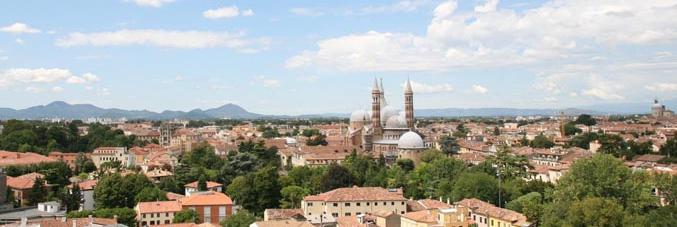
How many and where are in the city of Padua the vegetated areas that, today more and more, are of fundamental importance to ensure sustainability in the management of urban land and the quality of life of its inhabitants?
This is the purpose of the study “Whose is the urban green? Mapping and classification of public and private green areas in Padua, in support of policies for territorial planning published in the international journal “ISPRS International Journal of Geo-Information” and conducted by a research team of the University of Padua within the research on urban sustainability conducted by the group “Climate Change, Territories, Diversity”of the Department of Civil and Environmental Engineering (Icea) of the University of Padua.
The research aimed to calculate and geovisualize at a detailed scale the urban green in the city of Padua, classifying it between public (municipal green and green of other entities) and private.
“According to the last ISPRA report of 2021, the city of Padua is among the top five Italian municipalities, among those with more than 100,000 inhabitants, for the rate of soil consumption – explains Salvatore Pappalardo, professor of the ICEA Department of the University of Padua and one of the authors of the study – In the last decade this phenomenon of soil sealing proceeds in the municipality at an average rate of 11-25 hectares per year, to the detriment of vegetated and agricultural soils. These dynamics, often irreversible, change of land cover require special attention to the size and distribution of green areas in the city.”
“The results of the territorial analysis within the city of Padua (93 km2 of surface) have been mapped: 52.2 km2green areas (56% of the municipal territory), of which 55% is composed of agricultural areas (28.8 km2). The Private green areas are predominant, occupying about 80% of the total green area (41,9km2); while of the 10,2 km2 of public green areas, about half are owned by the Municipality of Padua (5 km2 , about 9,6% of the total green area) – comments Massimo De Marchi, ICEA professor and co-author of the study Municipal green areas represent therefore 5,3% of the total surface of Padua. The analysis of the distribution of green and agricultural areas shows how the historical center is mainly made up of built-up areas, with a small presence of green areas, often sparse and of small-medium size. Proceeding radially towards the outside of the historic urban core, green areas become more dense and larger, while agricultural areas are increasingly present, with the exception of the industrial area”.
The study reveals that the city of Padua has 247.3 m2 of total green area per capita, considering both public green areas (municipal and not), and private and agricultural areas. The per capita public green of the city of Padua is 48.5 m2, while that of municipal green is 23.7 m2.
These values are in line with European standards, where citizens have access to about 18 m2of publicly accessible green space within the boundaries of their city, with a reference value of 20 m2 per person. This indicator, however, takes on a completely different value if we take into account the distribution of green space in the city in relation to population density in each urban unit.
The results of territorial analysis through GIS show in fact that the most densely populated urban units, such as the sectors of the historic center and those of Arcella, have lower values, both of total green and of municipal green per capita due to the large amount of built-up space. In contrast, the indicator shows high values for all the different categories of green in the less populated peripheral districts, mainly agricultural or industrial: examples of total green are the Salboro district, the Mandria or the industrial area. Remaining in the municipal green the five most critical urban unitsthat host about a quarter of the population are San Bellino, Piazze, Arcella, San Carlo, Sant’Osvaldo.
“The study presented in this article and, in particular, the results of the classifications on the ownership status of green areas and the elaboration of indicators for the city green, provide methodologies and spatialized and geo-referenced data to support urban planning, for a more sustainable and resilient management – concludes Francesca Peroni, University of Padua and corresponding author of the study -. In particular, it is shown how private gardens and agricultural areas, predominantly present in the city of Padua, can be important “providers” of ecosystem services to mitigate the environmental problems of the city, even if they are not directly accessible and usable by the whole population”.
Data, maps and graphs at www.mastergiscience.it/2021/09/14/verde-urbano-a-padova
Questo articolo è disponibile anche in: Italiano (Italian)